
Summary
- The greenfield design supports two AMD Helios clusters with a combined IT load of up to 10.4MW.
- Individual racks can reach 246kW, with liquid cooling designed to remove up to 84% of generated heat.
- The current reference design is validated to US ANSI standards, with IEC support planned.
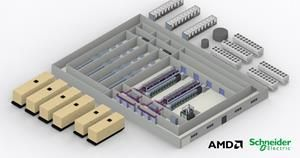
Schneider Electric and AMD have published a validated data centre reference design for Helios rack-scale systems, setting out the electrical, cooling, floor-space, and control infrastructure needed for racks drawing up to 246kW.
The greenfield configuration covers two 2,880-GPU clusters with a combined IT load of up to 10.4MW. A separate retrofit model examines how an existing hall arranged around four 2.5MW power trains and racks averaging 20kW could accommodate ten Helios rack-scale systems.
Liquid-to-liquid coolant distribution units sit at the centre of both designs, while perimeter fan walls, hot-aisle containment, or rear-door heat exchangers handle the remaining air-cooled load. Schneider says the liquid system can remove up to 84% of the heat generated by the computing equipment.
A quarter of a megawatt in one rack
At 246kW, each rack becomes a major electrical and mechanical load in its own right. Busway ratings, cable routes, protection settings, connection points, structural loading, pipework, controls, and maintenance clearances all have to be designed around a concentration of equipment far above the densities used in many operating data halls.
The reference design uses Schneider’s Motivair MCDU-70 coolant distribution units and adiabatic dry coolers in the greenfield arrangement. The CDUs separate the facility water loop from the technology loop, allowing each side to operate with different temperatures, pressures, and water chemistry, but they also introduce pumps, heat exchangers, valves, filters, controls, and additional failure modes.
Removing 84% of heat through liquid leaves roughly one-sixth to be managed through air at the stated design condition. Across a 10.4MW cluster, that residual load remains large enough to require a carefully engineered air system, particularly when networking, memory, power electronics, and other components continue to reject heat into the room.
The electrical system faces equally demanding transients. Rack-scale AI equipment can move rapidly between load states, creating power-quality and control challenges that are less visible in a steady-state megawatt figure. Transformers, UPS systems, batteries, distribution equipment, and generators must tolerate both the total load and the speed at which it changes.
A reference design is not a standard building
Pre-engineered designs reduce the number of assumptions made independently by chip suppliers, rack manufacturers, consultants, contractors, and operators. They can also expose capacity gaps earlier, before a project discovers during fit-out that its distribution or cooling system cannot support the selected hardware.
The published PUE of approximately 1.12 is a full-load design result rather than a measured annual figure from an operating facility. Climate, utilisation, cooling-water temperatures, redundancy state, plant staging, and part-load performance will determine whether a completed deployment approaches that level over a full year.
Retrofitting an existing hall presents a different problem from building around Helios from the outset. Removing conventional racks may create floor space, but it does not create incoming utility power, transformer capacity, heat-rejection plant, structural strength, or space for CDUs and pipework. The most expensive changes may sit outside the white space.
Water use also needs to be assessed alongside energy efficiency. The greenfield design uses adiabatic dry coolers, which can reduce compressor demand by using evaporative assistance under selected ambient conditions. Actual water consumption will vary with climate, operating temperatures, control settings, and the number of hours during which adiabatic operation is used.
The current design has been validated against US ANSI requirements. Schneider plans to extend the framework to IEC standards, but European projects will still need adaptations for local electrical codes, fire rules, utility conditions, water permits, noise limits, and the operator’s chosen resilience model.
Helios places the facility and the computing system inside the same engineering problem. Once one rack approaches a quarter of a megawatt, decisions about processor architecture, electrical distribution, cooling water, controls, and building layout can no longer be made in separate workstreams.

