
Summary
- Environmental groups have threatened legal action over gas-powered off-grid data centre projects involving Vantage and VoltaGrid.
- The challenged power plan reportedly includes 423MW of gas generation and 454MW of diesel backup capacity.
- The dispute shows how behind-the-meter power can reduce grid dependence while increasing permitting, emissions, and public scrutiny.
Vantage Data Centers and VoltaGrid are facing threatened legal action over two planned gas-powered, off-grid data centre projects near San Antonio, Texas.
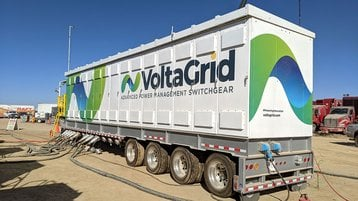
The threatened action has been brought by environmental groups that argue the companies failed to secure the necessary permits for the data centres and associated on-site generation. The power plan reportedly includes two gas-fired plants with combined capacity of 423MW and 151 diesel backup generators with 454MW of backup capacity.
The groups have raised concerns under the Clean Air Act, arguing that the generation assets should not have been treated as minor sources of pollution. If the dispute is not resolved, the groups have warned that they will file suit in the US District Court for the Western District of Texas.
Behind-the-meter power moves the problem
Off-grid and behind-the-meter power are becoming more attractive as grid queues lengthen and AI loads rise. For a developer, on-site generation can offer a route around delayed utility connections, reduce exposure to grid congestion, and provide greater control over power supply for large campuses.
That control comes with a different set of burdens. Gas generation needs fuel supply, emissions permits, safety systems, noise controls, operations staff, and maintenance regimes. Diesel backup brings fuel storage, testing schedules, generator maintenance, emissions exposure, and local air-quality concerns. A project may sit partly outside the grid, but it still sits inside an environmental and planning system.
The San Antonio dispute shows how a power workaround can become the main point of vulnerability. Developers solving for speed-to-power may find themselves exposed to air permitting, public participation rules, community opposition, and legal delay. Those risks can be as damaging to delivery as a delayed grid connection.
Vantage and VoltaGrid have already worked together on off-grid gas generation across Vantage’s North American portfolio. That strategy reflects a wider industry problem: the AI capacity race is moving faster than utility infrastructure in some regions, and developers are looking for private power paths.
Europe will face the same trade-offs
Large gas-backed off-grid data centres have not become a dominant European model, but the pressure behind them is visible. Developers are exploring batteries, private wires, power purchase agreements, on-site generation, and hybrid energy arrangements to reduce the risk of grid delays. Some of those approaches can support decarbonisation and flexibility. Others sit uneasily with emissions targets and reporting rules.
European operators are also moving into a more transparent sustainability regime. Energy sourcing, water use, heat reuse, and grid flexibility are all drawing more attention from regulators, lenders, and customers. A facility that relies heavily on fossil generation may win near-term power certainty while creating longer-term problems around permitting, emissions disclosure, finance, and public consent.
Resilience claims also need careful handling. On-site generation can improve facility control during grid outages, but it adds equipment, fuel, compliance, and maintenance risk. Large generator fleets are not invisible support systems. They affect air permits, local noise, operational procedures, fuel logistics, and emergency planning.
The Texas dispute marks a harder phase of the data centre power debate. As AI infrastructure pushes loads beyond the pace of grid reinforcement, developers will continue to seek private energy routes. Courts, regulators, and communities will then test whether those routes meet environmental rules and public expectations.

