
Summary
- Vertiv Rack Extreme supports static and dynamic load ratings of up to 2,045kg for high-density AI and HPC deployments.
- The platform is designed around deeper equipment, airflow, cable management, mobility, and integration with rack power and cooling systems.
- The launch shows how AI infrastructure is changing the data hall floor, where weight, movement, cabling, and thermal interfaces now shape buildability.
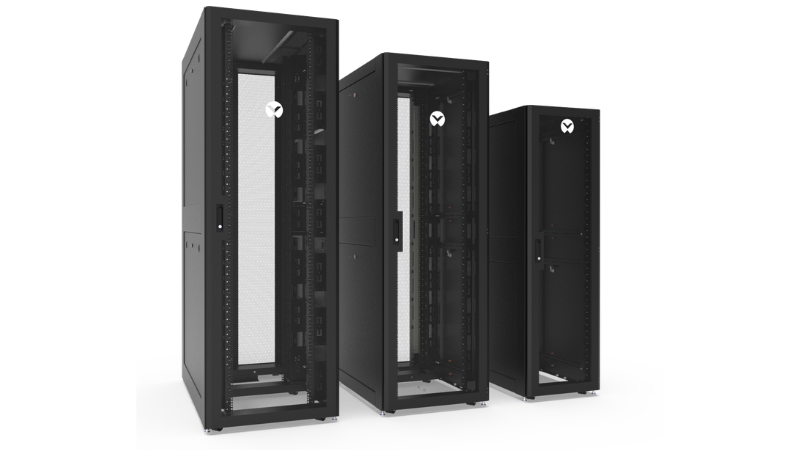
Vertiv has launched a high-capacity rack platform for AI and high-density IT deployments, targeting the weight, depth, airflow, and cabling pressures that are building inside data halls.
The Vertiv Rack Extreme supports static and dynamic load ratings of up to 4,500lb, or 2,045kg. The same rating applies whether the rack is stationary or being moved, giving the cabinet full-rated mobility during installation, reconfiguration, and on-site handling.
AI infrastructure is usually described through GPUs, megawatts, and liquid cooling, but the rack itself is becoming a limiting component. Dense server platforms can be heavier, deeper, hotter, and harder to cable than the enterprise equipment many facilities were originally designed around. When those racks have to be moved, installed, connected, and maintained safely, mechanical design becomes part of capacity delivery.
Heavy equipment changes the hall
Vertiv says Rack Extreme uses a fully welded frame, 2.5mm mounting rails, deeper configurations, high open-area mesh doors, vertical cable bars, corner rPDU mounting bars, flexible rail systems, and engineered shipping systems including shock-absorbing pallets and multi-use ramps.
The platform is designed to integrate with Vertiv UPS systems, rack PDUs, rear-door heat exchangers, CoolChip CDU coolant distribution units, liquid-to-chip manifolds, and Avocent KVM and serial console systems. That ecosystem approach fits a market moving away from isolated rack, power, and cooling purchases towards coordinated infrastructure blocks for dense compute.
The mobility rating is one of the more practical details. A rack that can support a heavy static load but cannot be moved at that weight creates problems before the equipment is even powered. Delivery routes, staging areas, ramps, floor protection, lifting methods, goods lifts, and installation labour all have to be planned around the real weight of populated racks.
Vertiv says the platform delivers up to twice the dynamic capacity and 1.3 times the static capacity of conventional designs. That higher load rating is not only about extreme future use cases; it also gives operators more headroom as server platforms, power shelves, cabling, and cooling interfaces become heavier.
Buildability moves inside the rack row
New AI facilities increasingly need to consider rack weight, depth, power delivery, heat extraction, cable density, and service space as a single design problem. Slab loading, rack layout, containment, busway or cable routing, leak detection, drainage, rear-door cooler clearance, and maintenance workflows all interact in ways that are difficult to correct once the hall is built.
Existing European colocation sites face a tougher test. A site may have strong connectivity and available power, but still struggle to accept dense AI equipment if floor loading, access routes, cooling distribution, or cable tray capacity are not aligned with the customer deployment. Marketing a facility as AI-ready is easier than proving that heavy racks can be delivered, positioned, connected, and maintained without disrupting live operations.
Heavier racks also change operational risk. Maintenance windows, replacement cycles, and emergency intervention all depend on safe physical access. As rack weight rises, procedures that once looked routine can require different tools, more people, tighter method statements, and greater attention to health and safety.
The Rack Extreme does not remove the wider power and cooling bottlenecks around AI infrastructure. A stronger cabinet still has to sit inside a facility that can supply the load, reject the heat, manage liquid interfaces where required, and preserve resilience through failure and maintenance events. It does, however, address one of the less visible constraints that can slow or complicate dense deployment.
AI capacity will increasingly be judged by deployable capacity rather than announced megawatts. If racks cannot be transported through the building, loaded safely onto the floor, cooled effectively, and serviced without excessive operational friction, power capacity becomes theoretical. Vertiv’s new rack platform sits at that point where the physical data hall catches up with the density of the IT roadmap.

