
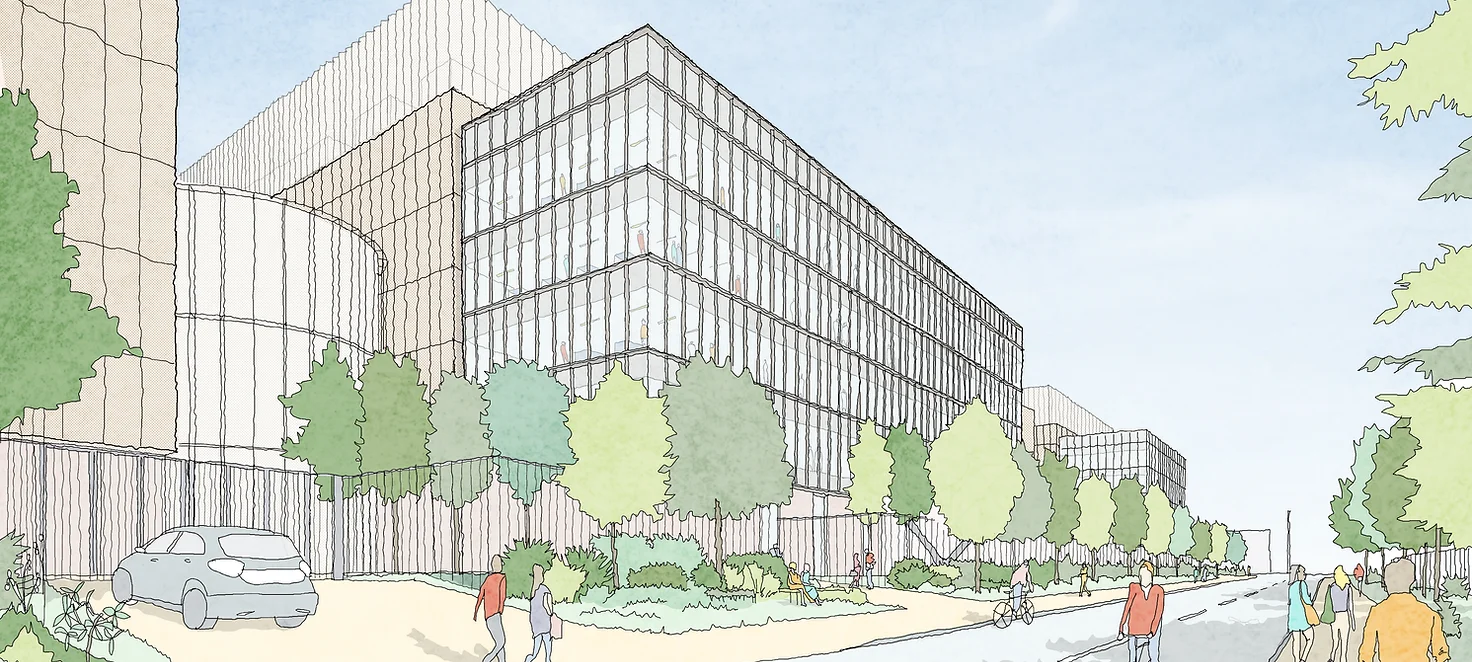
Summary
- Two applications cover the LD15 building and initial site infrastructure, including access, utilities, landscaping, and an interim substation.
- The three-building campus received outline permission on 30 July 2026 for up to 90,614m² of development.
- Detailed approval remains outstanding, with representations invited until 5 December and no confirmed operating power capacity.
Equinix has submitted two detailed planning applications for the first building at its proposed Wexham Road data centre campus in Slough, setting out the design and supporting infrastructure for a development that already has outline permission.
Slough Borough Council published notices on 13 November covering the LD15 building and a separate package of site infrastructure works. Both submissions concern reserved matters under outline permission P/00072/152, granted on 30 July 2026.
The wider scheme provides for three data centre buildings, designated LD15, LD16, and LD17, on part of the former AkzoNobel decorative paints manufacturing site. The outline permission allows up to 90,614m² of gross external area, together with ancillary offices, electrical infrastructure, plant, and associated works.
The new applications do not seek permission for a separate campus. Instead, they provide the design details required to implement parts of the previously approved development.
Application P/00072/173 covers site-wide infrastructure, including an additional vehicle entrance, internal roads, pedestrian and cycle routes, parking, landscaping, and an interim electrical substation.
It also includes underground utilities and services, together with work within the LD15 footprint extending to damp proof membrane level. The accompanying application, P/00072/174, addresses the building above that level, including its appearance, layout, scale, ancillary offices, and technical plant.
Both submissions seek partial discharge of conditions relating to development phasing, design code compliance, biodiversity net gain, and security and access arrangements.
The council has invited representations within 22 days of its 13 November notice, giving a consultation deadline of 5 December. The applications remain subject to determination, and detailed approval should not be confused with the earlier decision to permit the overall development in principle.
Preparing the first phase
Splitting the infrastructure and building submissions reflects the engineering sequence involved in constructing a large data centre campus. Access routes, drainage, underground services, and electrical distribution infrastructure must be coordinated with the buildings that will eventually occupy the site.
Substations are particularly important because a data centre requires suitable electrical infrastructure before its computing equipment can be commissioned. The latest application includes an interim substation, while the wider development provides for additional electrical infrastructure as later phases progress.
The published statutory notice does not specify the electrical rating of the interim substation or the campus’s final IT load. No confirmed grid connection capacity, operating power figure, or commissioning date has been established from the reviewed applications.
The development’s permitted floorspace is therefore not a reliable basis for calculating its eventual electrical demand. Building areas can accommodate different quantities and densities of computing equipment, with substantial differences in power distribution, cooling requirements, and associated technical space.
Detailed engineering must also establish the physical interfaces between the buildings and supporting infrastructure. Cable routes, plant locations, maintenance access, emergency arrangements, and the layout of underground services can influence the capacity and configuration of the eventual installation.
The outline planning framework envisaged development over several phases. Earlier council material described initial access and infrastructure works followed by LD15, LD16, and LD17, with the complete programme potentially extending over approximately 20 years.
That programme provides the planning context for phased delivery rather than a confirmed timetable for construction or operation. The pace of later buildings will depend on subsequent approvals and commercial and engineering arrangements.
Redevelopment of industrial land
Equinix’s project occupies part of the former AkzoNobel manufacturing property between Wexham Road, Technology Boulevard, and the Great Western Main Line.
Another portion of the wider former industrial site is associated with a separate Yondr data centre development. The facilities should not be combined when assessing the Equinix planning application, building areas, or infrastructure requirements.
The site’s previous industrial use provides an established development context, but construction of a data centre still requires assessment of ground conditions, utilities, access, electrical equipment, cooling plant, and the effects of the proposed buildings on surrounding land.
The current reserved matters process addresses several of those requirements through plans for access, layout, appearance, landscaping, and associated infrastructure.
Security arrangements are another consideration. Data centre campuses typically require controlled entry and protected technical areas, but those measures must be designed alongside emergency access, pedestrian movement, and the local road network.
Biodiversity net gain obligations also form part of the planning conditions. The latest applications seek approval of relevant details, rather than establishing that every environmental obligation associated with the development has already been discharged.
The original outline proposal was considered by the council’s Planning Committee in November 2025. A motion to refuse the scheme because of the scale and mass of the proposed buildings was defeated, and councillors subsequently supported delegated approval subject to legal arrangements.
Outline permission was issued on 30 July 2026. The new submissions are therefore a subsequent planning milestone, not a reconsideration of the original principle of development.
The reserved matters stage will determine whether the detailed proposals comply with the approved planning parameters and relevant conditions. Approval would allow the specified elements of the development to progress, subject to any remaining permissions and implementation requirements.
Equinix has not disclosed a confirmed start date for LD15 construction in the latest applications, nor has it announced when the first computing equipment is expected to enter service.
The immediate next step is the council’s consideration of the two reserved matters submissions, including consultation responses received before 5 December.

