
Summary
- Submer plans to invest more than €1bn at the former Ercros plant in Flix, Catalonia.
- Rubix Data Centers will develop and operate the two-phase AI infrastructure campus.
- The project ties industrial land reuse to AI capacity, liquid cooling, power access, and regional reindustrialisation.
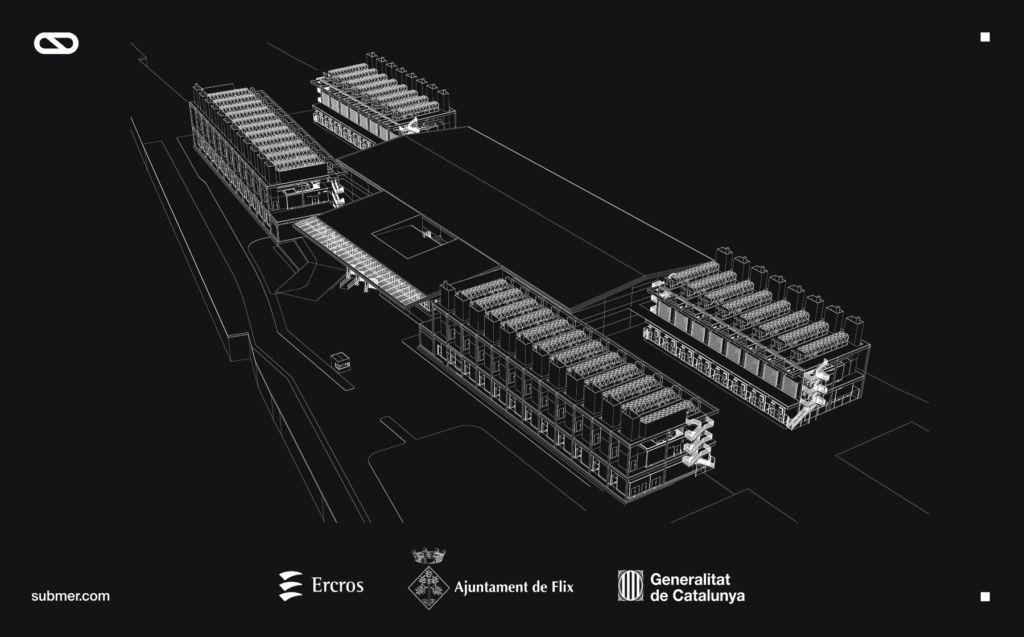
Submer plans to invest more than €1bn in a new AI data centre at the former Ercros industrial site in Flix, Catalonia, turning a legacy chemicals location into a large-scale digital infrastructure project.
The Barcelona-headquartered company said the development will be built in two phases at the Ribera d’Ebre site, with Rubix Data Centers, a Submer Group company, set to develop and operate the facility. Submer said the campus is being designed as a next-generation AI data centre using energy-efficient liquid cooling technology that uses no water during operations.
The project gives Catalonia a substantial AI infrastructure scheme outside the most familiar Madrid and Barcelona data centre geography. It also brings industrial land reuse into the centre of the data centre build-out, where available power, permitting history, local workforce capability, and heavy-infrastructure adjacency can carry as much weight as proximity to an established colocation cluster.
From chemicals to compute
The former Ercros plant gives the project a physical starting point that many greenfield schemes lack. Sites shaped by heavy industry often have stronger utility history, larger parcels of land, and communities familiar with industrial operations. They can also carry remediation duties, environmental scrutiny, and a need to show that new infrastructure will create durable local value rather than simply replace one fenced-off industrial user with another.
Submer said the project has been developed with support from Catalonia’s Department of Business and Labour and under the framework of reindustrialisation round tables, which are intended to move former industrial plants into new uses. On completion, the facility is expected to support up to 150 permanent roles across operations and maintenance, critical facilities engineering, facilities management, security, site services, and operator support.
The cooling strategy is central to the scheme. Submer is best known for immersion and liquid-cooling infrastructure, and the Flix project allows the company to apply that engineering position at campus scale rather than only as a supplier into other operators’ data halls. Dense AI infrastructure changes the mechanical and electrical design of a facility, affecting heat rejection, plant selection, pipework, controls, maintenance practice, commissioning, and space planning.
The Rubix model also shifts Submer further into development risk. Selling cooling technology is different from assembling land, power, buildings, permits, customers, and operating procedures. A developer-operator role puts the group closer to the commercial exposure carried by colocation providers, hyperscale developers, powered-land specialists, and infrastructure investors.
Catalonia pushes beyond the core hubs
Iberia’s data centre market has been shaped heavily by Madrid, Barcelona, and the growing appeal of Spanish renewable power. Flix adds a more industrial and regional angle. The site is not being presented as another metropolitan interconnection hub, but as a location where AI infrastructure, local reindustrialisation, and liquid-cooling-led design can be pulled together.
That approach reflects a wider European search for sites that can host large AI loads without running straight into the power, land, and planning constraints affecting more mature data centre markets. The pressure is particularly acute for AI facilities because dense GPU deployments need power and cooling earlier in the project lifecycle. A building shell without a credible route to energisation and heat rejection is not useful capacity.
The project will still have to prove its execution path. Industrial land does not automatically translate into a bankable AI campus. Grid capacity, connection timing, local environmental controls, fibre connectivity, customer commitments, capital discipline, and construction sequencing will determine whether the headline investment becomes operational compute.
Spain’s power position gives developers reasons to look seriously at the market, particularly where renewable procurement and land availability are stronger than in some northern European hubs. The harder task is matching those advantages with firm, resilient power for a high-density facility that has to run continuously. AI infrastructure does not only need clean electricity on paper; it needs controllable power at the point of use, supported by redundant systems and clear operating responsibilities.
The Flix scheme brings together several themes now shaping Europe’s data centre market: industrial land reuse, AI sovereignty, cooling density, regional economic policy, and the search for developable power. Its success will be measured less by the €1bn figure than by whether Submer and Rubix can turn a former chemicals site into a reliable operating platform for compute-intensive workloads.

