
Summary
- Google has been named as the sole end user and operator of the Columbia County Data Center in Georgia.
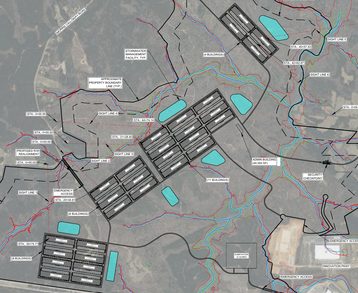
- The project is planned across about 1,900 acres and includes 23 data centre buildings.
- The scale offers a clear contrast with European markets where land, power, planning, and public consent limit campus growth.
Google has been named as the sole end user and operator of the Columbia County Data Center in Georgia, a planned 8 million sq ft campus that shows how large hyperscale development is becoming in less constrained US markets.
The project is expected to cover about 1,900 acres northwest of the existing White Oak Business Park and include 23 data centre buildings. The county’s Economic Development Authority named Google during an announcement on 23 July.
Site plans for a project of that size point to an infrastructure district rather than a single facility. A campus spanning thousands of acres needs data halls, substations, internal roads, stormwater systems, cooling infrastructure, backup power, security perimeters, construction staging, and room for future phases.
Scale changes the planning conversation
An 8 million sq ft campus carries a different set of questions from a standard colocation or cloud region expansion. The headline floor area only captures part of the physical footprint. Power compounds, mechanical plant, water systems, transmission routes, generator yards, laydown areas, and utility corridors can define the site as much as the buildings themselves.
Google’s position as sole end user gives the project a clearer demand profile. Large campuses need anchor credit and long-term operating control, especially when power delivery, construction packages, and equipment procurement extend across multiple years. A single hyperscale operator can standardise design, resilience, maintenance, and sustainability reporting across the site.
The local debate is still likely to centre on infrastructure effects. Large data centre campuses can increase tax revenue and support roads, schools, and public services through the commercial tax base, but they also raise questions over power costs, land use, environmental impact, construction traffic, and whether the economic benefits match the scale of public infrastructure required.
The project was discussed alongside wider US political attention on data centre power costs. That reflects a growing concern across markets: the public wants assurance that large digital loads will not raise electricity bills, overwhelm local infrastructure, or receive preferential treatment without corresponding local value.
Europe cannot simply copy the model
The Georgia project is a useful contrast with Europe’s development environment. A 1,900-acre data centre campus would be difficult to deliver near most established European hubs. London, Dublin, Amsterdam, Frankfurt, Paris, Milan, and Madrid all face tighter combinations of land scarcity, grid constraints, planning scrutiny, and community sensitivity.
European campuses will still grow, but they are likely to follow a different pattern. Some capacity will move towards the Nordics, Iberia, Central and Eastern Europe, and other regions where power and land are more available. Other projects will be distributed across smaller sites or tied to national AI infrastructure programmes rather than concentrated in vast single-user campuses.
AI demand is increasing the pressure on both models. Operators want larger blocks of power, more space for cooling and electrical infrastructure, and sites that can support denser racks. Governments want domestic compute capacity and investment. Communities want clarity on energy costs, water, noise, land use, and jobs.
Google’s Georgia campus shows what hyperscale expansion can look like when land and development scale are available. Europe’s challenge is different: turning smaller, more contested, and more regulated sites into enough capacity to support cloud and AI demand without losing control of grid planning, sustainability, and local consent.

