
Summary
- HPE's rack management controller integrates cooling telemetry, leak detection, and control functions with its supercomputing management software.
- Initial support for HPE Cray GX systems is planned for March 2027, followed by AMD and NVIDIA rack-scale systems in June.
- New E2000 hybrid storage configurations combine SSDs with 32TB SAS-4 drives, with availability expected in early 2027.
Hewlett Packard Enterprise has introduced a rack management controller intended to coordinate liquid cooling monitoring and control within high-density computing installations, alongside new hybrid storage configurations for its Cray supercomputing systems.
The developments, disclosed on 12 November, address two infrastructure requirements associated with expanding high-performance computing installations: maintaining reliable operating conditions within densely populated racks and accommodating larger datasets without proportionate increases in storage equipment.
The HPE Rack Management Controller combines real-time monitoring, leak detection, automated control, and rack-level visibility. It is designed to integrate with the company’s existing Supercomputing Management Software suite rather than operate solely as an independent monitoring device.
Initial support for HPE Cray Supercomputing GX systems is scheduled for March 2027, with subsequent support for AMD and NVIDIA rack-scale systems expected in June. HPE has not identified a completed deployment of the new controller.
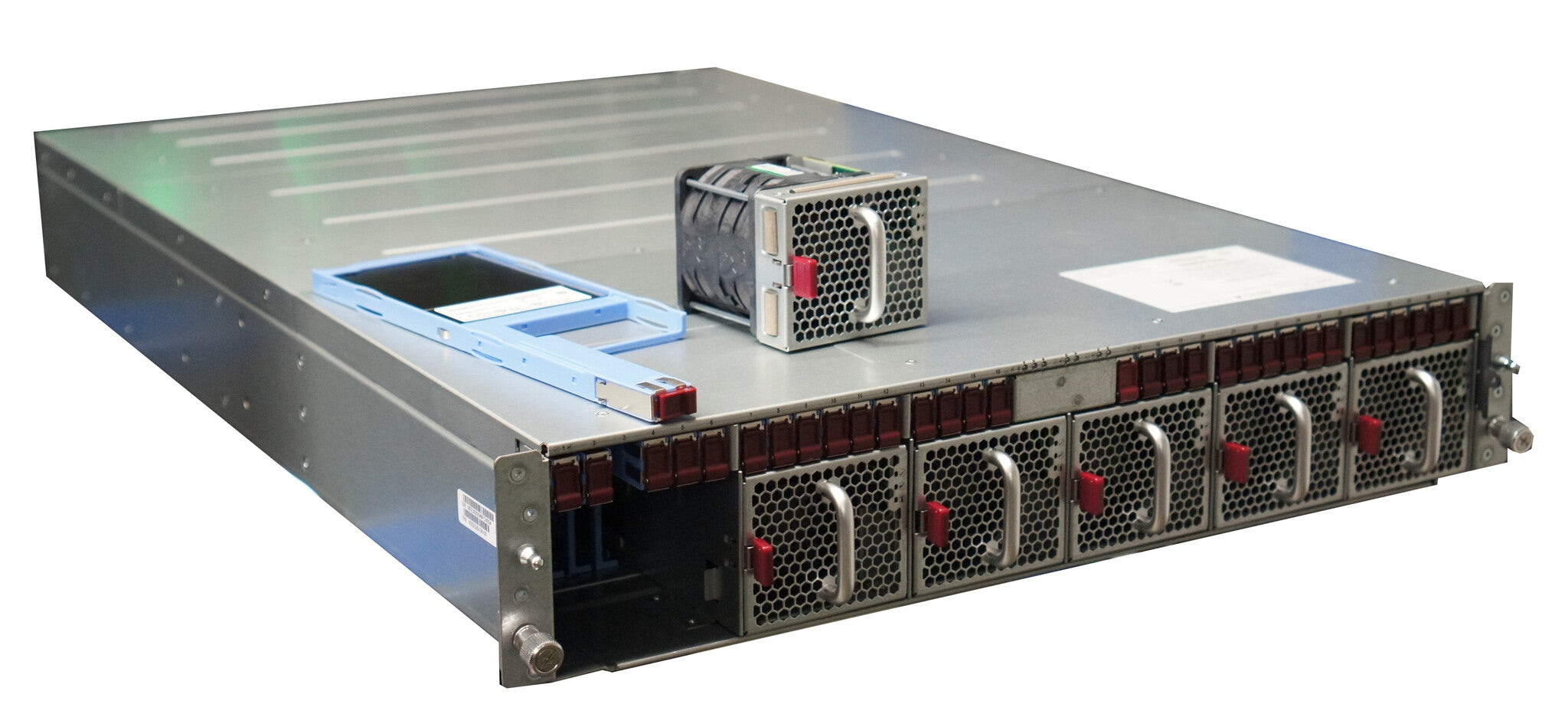
The accompanying storage development introduces hybrid configurations of HPE Cray Supercomputing Storage Systems E2000, combining solid-state drives with new 32TB SAS-4 hard drives in enclosures accommodating 74 or 100 drives.
HPE states that the configurations can deliver up to 116GB/s of read throughput and 92GB/s of write throughput per rack, while providing up to 32% more usable capacity than its currently shipping hybrid E2000 configurations.
These figures are supplier performance claims based on specified configurations. They do not establish that every installation will achieve equivalent results under different workloads or equipment arrangements.
Availability of the new storage configurations is planned for early 2027. HPE has not disclosed a confirmed customer installation associated with the announcement.
Connecting cooling controls with computing operations
High-density computing systems produce substantial thermal loads within concentrated areas of a data hall. Direct liquid cooling removes heat from processors and other components by circulating coolant through equipment connected to the facility’s cooling infrastructure.
The arrangement requires coordination between computing hardware, coolant distribution units, pumps, valves, heat exchangers, and monitoring systems. A failure involving coolant circulation can affect multiple processors or servers even when the computing equipment itself remains functional.
Monitoring these conditions at rack level allows the operating team to identify problems closer to the equipment they affect. Temperature, coolant flow, leakage, and the status of supporting hardware can provide information about emerging faults.
HPE’s controller is intended to bring those observations into the same management environment used to supervise its computing installations. It integrates with HPE Foundation for infrastructure management, Composable for resource sharing, and Observability for operational monitoring.
The system supports platform-specific variants, recognising that different rack architectures can require different cooling and electrical arrangements.
Information from liquid cooling equipment can help identify conditions requiring investigation or intervention. Automated control may also allow specified actions to be initiated through the rack management system, subject to the equipment and control architecture deployed.
HPE has not published the full interface specification or detailed logic governing those automated actions. The controller’s announcement therefore does not establish a universal ability to prevent coolant leaks, eliminate downtime, or control every connected facility system.
Where automated responses include closing valves or changing equipment operation, the effects must be considered across the complete cooling circuit. Isolating one section of pipework can alter circulation elsewhere, while an interruption to cooling may require the affected computing equipment to reduce output or shut down.
The supporting electrical systems also remain relevant. Cooling equipment, sensors, controllers, and network connections need suitable power and resilience arrangements if monitoring and protective functions are to remain available during infrastructure faults.
Increasing storage capacity within existing space
The hybrid E2000 configurations address a different constraint: supporting growing volumes of data while controlling the quantity and cost of storage hardware installed.
Combining SSDs and high-capacity hard drives allows storage systems to balance different performance and capacity requirements. SSDs can serve data requiring faster access, while hard drives provide substantial capacity at a different cost and performance point.
HPE claims up to 41% higher throughput per storage rack than a specified competing hybrid supercomputing storage system. Its claimed acquisition-cost advantage of up to 82% is based on a comparison with an all-flash configuration meeting defined capacity and performance requirements.
The company’s published comparison uses 15PB of usable storage for a cluster containing 1,024 GPUs. Those assumptions are important because the economics of hybrid storage depend on workload behaviour, required throughput, capacity, and the hardware configuration selected.
Neither comparison establishes a universal cost or performance advantage across all competing products.
Greater storage capacity per rack can reduce the number of enclosures required for a specified dataset, but facility-level consequences must be assessed separately. Electrical consumption, cooling demand, equipment weight, network connectivity, and maintenance access can all affect the viability of a storage configuration.
High-throughput storage also depends on its connection to the wider computing environment. The performance delivered to applications can differ from the maximum throughput measured at the storage system itself, particularly where network capacity or workload behaviour introduces constraints.
HPE’s two developments therefore address different parts of the computing infrastructure. The rack controller is intended to improve visibility and control of supporting physical systems, while the hybrid storage configurations provide additional capacity and specified throughput within an established equipment footprint.
Both are scheduled for availability during 2027. Their effectiveness in operational facilities will depend on the supported computing platforms, installed storage configurations, and the electrical and cooling infrastructure surrounding them.

