
Summary
- Police Scotland has advised that the Larbert project should prepare for possible disruptive incursions amid substantial public opposition.
- Apatura is seeking permission for a 300MW campus on around 50 acres at Glenbervie Business Park.
- Security planning now sits alongside power, backup generation, environmental effects, and community opposition in the assessment of the project.
Police Scotland has urged security planning around a proposed 300MW data centre at Larbert as sustained opposition raises the prospect of disruptive incursions during the development and operation of the site.
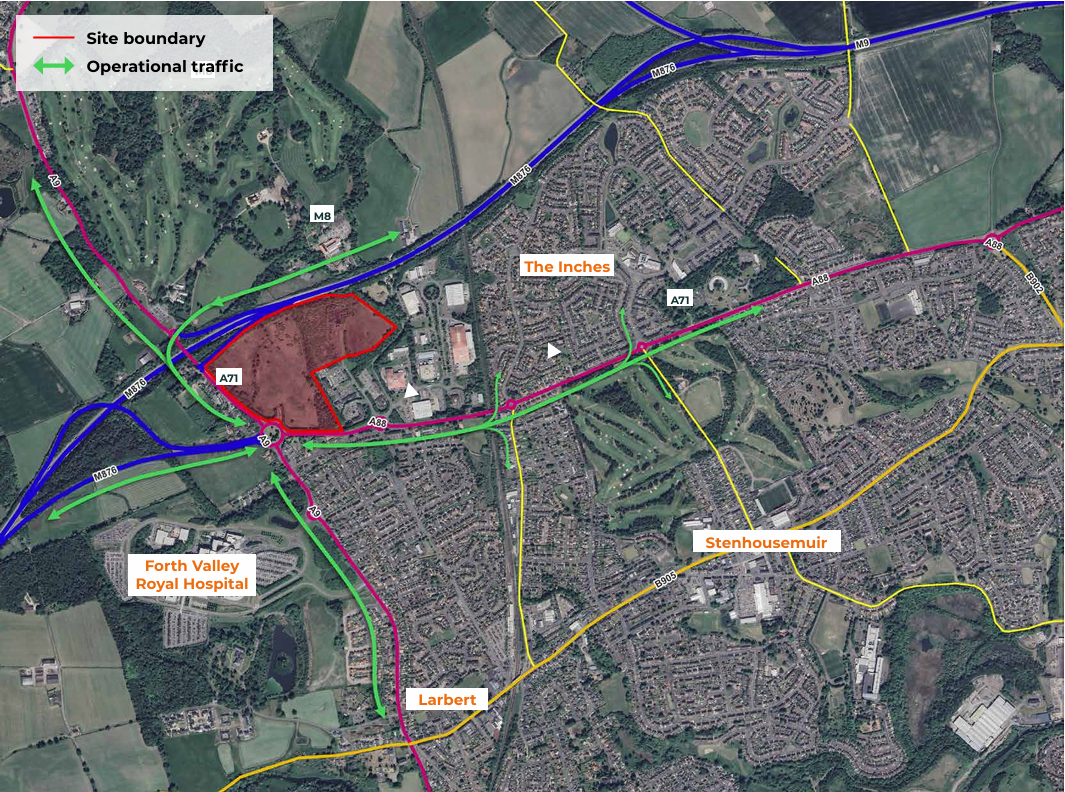
Apatura is seeking planning permission for the campus on around 50 acres at Glenbervie Business Park, beside Bellsdyke Road. The developer has a grid agreement for the project, which would connect through the nearby Denny substation.
The police response forms part of the planning consultation and advises that substantial public opposition is likely, with liaison encouraged to reduce the risk of unplanned access intended to disrupt the site. Nearly 7,000 objections have been reported, while more than 100 people attended a protest this week.
Physical resilience enters the planning record
The police intervention does not indicate that an attack is expected, but it puts perimeter design, access control, protest management, and liaison with emergency services into the practical assessment of the campus.
Data centre security is frequently discussed through cybersecurity, although the physical site contains every system needed to keep digital services running. Substations, generators, fuel installations, cooling plant, fibre routes, loading areas, and control systems can all become operational dependencies that need protection independently of the servers themselves.
A large campus also has a long construction phase before permanent security systems are fully operational. Transformers, generators, switchgear, cooling equipment, cable, fuel infrastructure, and control systems move through temporary compounds as the project develops, often with individual components carrying long replacement lead times.
Construction access therefore has to remain sufficiently open for logistics while preventing unauthorised entry into areas containing valuable or safety critical equipment. The balance becomes more difficult where a development is already attracting organised public protest.
Apatura’s project programme envisages construction beginning in 2027, completion in 2028, and operation from 2029, subject to planning and other approvals.
A 300MW campus carries a larger resilience footprint
The proposed utility demand capacity places Larbert among Scotland’s larger data centre projects. At that scale, resilience extends beyond the data halls into high voltage power, emergency generation, fuel logistics, cooling systems, water, communications routes, and the roads used by staff and maintenance teams.
Local objections have already focused on the project’s scale, backup power, and environmental effects, with the planning debate reflecting how much supporting infrastructure sits around a large AI oriented campus.
Backup generation has been particularly prominent in the opposition. Generators provide resilience during loss of grid supply, but a large fleet also creates questions around emissions, fuel storage, testing noise, maintenance, and how frequently the equipment is expected to run.
Those systems are normally designed for exceptional events rather than continuous electricity production, although their scale can be substantial because they have to support enough of the electrical and cooling system to keep IT services within the operator’s resilience envelope.
The UK’s designation of data centres as critical national infrastructure has also increased attention on operational continuity. Large sites can host cloud, public sector, financial, telecommunications, and enterprise workloads whose disruption extends well beyond the facility boundary.
Physical security measures consequently form part of resilience design alongside redundant power and cooling. Fencing, controlled gates, vehicle stand-off, surveillance, secure plant compounds, lighting, and separation of critical systems all affect how a campus responds to unauthorised access or disruption.
Security has to coexist with the planning environment
A heavily defended perimeter can create its own planning challenges, particularly where a site is visible from nearby roads or homes. Boundary treatments, landscaping, security lighting, road layouts, and vehicle controls need to meet operational requirements without creating unnecessary additional impact.
Apatura’s site lies mainly on vacant grassland within the Glenbervie Business Park area and has been selected partly because of its access to electrical infrastructure. The proposed connection through Denny gives the project a stronger power route than many speculative developments, but the planning process still has to consider the physical effects of converting the land into a major industrial campus.
Police involvement adds another strand to that process rather than displacing existing environmental and infrastructure questions. The developer will have to demonstrate how construction and operation can continue safely if demonstrations occur around the site, while keeping access open for employees, contractors, emergency services, and equipment deliveries.
Larbert’s planning debate has therefore expanded from the size and environmental footprint of the campus into the practical question of how such a facility would be protected. If the project proceeds, security design will sit alongside substations, cooling, generators, and fibre as part of the physical infrastructure required to keep 300MW of proposed capacity operational.

