
Summary
- Falkirk Council has scheduled a pre-determination hearing for 16 September on application P/26/0237/FUL.
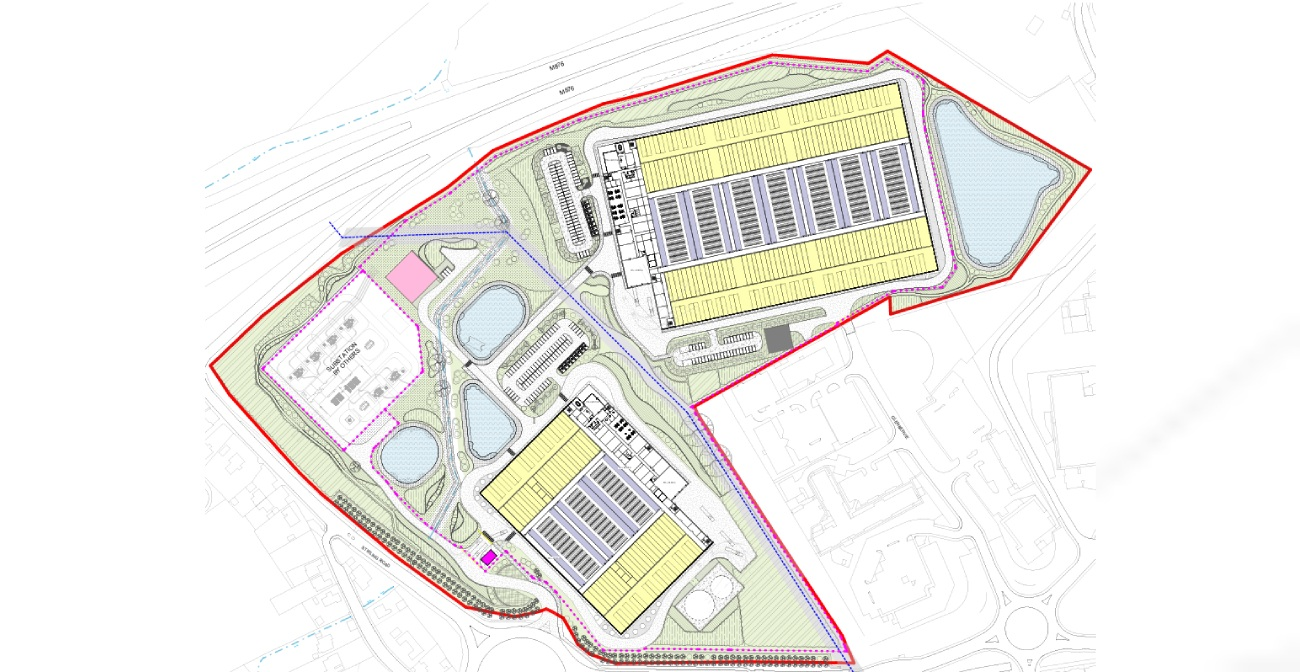
- Apatura is seeking permission for a 300MW data centre campus on land beside Glenbervie Business Park in Larbert.
- The developer cites confirmed grid connectivity and almost £1 billion of investment, while the proposal has also attracted significant local opposition.
Falkirk Council will hold a pre-determination hearing on 16 September for Apatura‘s proposed 300MW AI data centre campus at Larbert, giving councillors and interested parties a formal hearing before the application proceeds towards a planning decision.
The hearing is scheduled for 18:00 at Larbert High School and concerns application P/26/0237/FUL. The proposal covers construction of an AI data centre with 300MW of demand utility capacity, parking, landscaping, roads, access, and associated works on land to the northeast of Glenbervie Nursery.
The meeting is not a grant or refusal of planning permission. A pre-determination hearing gives councillors an opportunity to hear representations on a major development before the authority takes its formal decision.
Apatura submitted the full planning application in June for land beside Glenbervie Business Park. The developer says the site covers roughly 50 to 55 acres of mainly vacant land and has access to a high-capacity connection from the nearby Denny substation.
The company has described the project as representing almost £1 billion of direct investment in Scotland. It estimates more than 5,000 jobs per year during construction and more than 1,300 long-term roles during operation, including more than 500 local jobs. Those employment and investment figures are developer forecasts rather than realised outcomes.
Apatura says the campus would also connect to a consented battery energy storage project around two miles north of the site. Its current development timetable envisages construction activity from 2027, with operations planned to commence in 2028, subject to planning approval.
The scheme has drawn substantial opposition locally. Residents and campaign groups have raised concerns around noise, backup generation, air quality, energy demand, landscape impact, and proximity to homes and other community facilities. Action to Protect Rural Scotland has lodged a formal objection calling for the application to be refused.
The developer argues that Larbert’s grid access, transport links, existing employment-land allocation, and proximity to central Scotland make it suitable for large-scale digital infrastructure. It has also said the design is intended to minimise water use and be capable of supporting future heat recovery.
The competing positions place the application inside a wider Scottish debate about the pace and location of hyperscale data centre construction. Several projects measured in hundreds of megawatts are being promoted across the country as developers seek access to renewable generation and grid capacity that is harder to secure in some established UK markets.
That pipeline has also prompted calls for tighter national planning guidance. DataCentral has separately reported on a proposed Scottish parliamentary moratorium for hyperscale applications above 50MW while a national strategy is developed.
Larbert illustrates why the argument is increasingly centred on physical infrastructure rather than abstract digital demand. A 300MW connection is a major new electricity load. The facility also requires substations, backup systems, cooling plant, network infrastructure, access roads, and construction logistics at a scale more comparable with heavy industrial development than a conventional commercial building.
Apatura says it has more than 1.6GW of confirmed grid connections across a portfolio of Scottish sites. That power position is commercially significant because connection availability has become one of the principal constraints on new UK data centre development.
However, a grid agreement addresses only one part of buildability. Planning permission, environmental assessment, financing, customer demand, construction procurement, and delivery of electrical and mechanical plant all remain necessary before a proposed 300MW campus becomes operating capacity.
The pre-determination hearing brings those planning questions into a formal public setting. Councillors will have the council officer’s report and representations from parties involved in the application, but the hearing itself should not be confused with the final planning determination.
For Apatura, the immediate objective is to move a grid-ready site through that process. For Falkirk Council, the decision will have to weigh the economic and infrastructure case presented by the developer against the environmental and community issues raised through the application.
The 16 September hearing is therefore a planning milestone rather than the end of the process. Until the authority issues its formal determination, Larbert remains a proposed 300MW campus — albeit one with a claimed grid connection and a scale large enough to make the decision relevant well beyond the boundaries of the site.

