
Summary
- technotrans says July order intake for data centre liquid cooling has reached a double-digit million-euro volume.
- The company has added a fourth production line for coolant distribution units serving high-performance server cooling.
- Repeat CDU demand shows AI cooling moving from trials and first projects into a more industrial manufacturing phase.
technotrans has secured further follow-on orders for data centre liquid-cooling systems and expanded CDU manufacturing, as AI infrastructure demand pulls thermal-management suppliers into higher-volume production.
The German thermal management specialist says July order intake in its data centre cooling business reached a double-digit million-euro volume. The latest orders follow earlier 2026 demand, with the company saying order intake in the segment had already exceeded the previous year’s level by April.
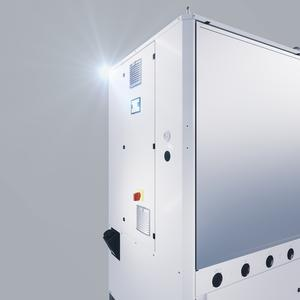
The company’s 15 July update centres on coolant distribution units, or CDUs, which manage liquid flow between the building cooling system and high-density IT equipment. CDUs have become a critical component in direct-to-chip architectures, where heat is removed close to processors rather than relying mainly on room-level air cooling.
The order book is changing
Liquid cooling has spent years moving through trials, high-performance computing deployments, and early hyperscale designs. AI workloads have accelerated that movement by pushing rack densities beyond the practical and economic limits of conventional air cooling. Operators trying to increase capacity inside constrained buildings, or deliver dense new AI halls, are now treating liquid cooling as part of the base design rather than a specialist overlay.
technotrans says it now operates four CDU production lines. That detail gives the market signal more weight than a routine product note. Once suppliers add production capacity, the commercial focus moves from proof-of-concept performance to repeatability, lead times, service support, and integration discipline. Data centre projects need equipment to arrive in sequence with construction, fit-out, commissioning, and customer handover.
CDUs sit in a demanding part of that stack. They regulate coolant temperature, pressure, and flow, while isolating the IT cooling loop from the building-side cooling infrastructure. Poor integration can create condensation risks, flow instability, maintenance complexity, leak exposure, or weak redundancy. At AI rack densities, cooling becomes part of the compute delivery model, not a background building service.
Supply chains move into the plant room
The order momentum also shows how thermal equipment can become a delivery constraint. Data centre developers already face long lead times for transformers, switchgear, generators, chillers, electrical distribution equipment, and other critical systems. As liquid cooling becomes mainstream for AI halls, CDUs, manifolds, cold plates, pumps, controls, sensors, and water-treatment systems join the list of items that can affect programme certainty.
That puts pressure on manufacturers to scale without weakening product quality or field support. AI data centre customers may want rapid deployment, but liquid systems need conservative engineering. Components must be tested, documented, serviceable, and compatible with the wider facility design. Failures inside a liquid loop can create operational risk that is harder to tolerate in high-density halls where many racks depend on a common cooling architecture.
Retrofitted sites face an even tighter integration challenge. Existing data centres may have strong grid connections and valuable locations, but they were often designed around lower-density air-cooled rooms. Adding liquid cooling can require changes to floor loading, pipe routes, leak detection, access space, controls, water quality, heat rejection, and maintenance procedures. CDU suppliers therefore sit at the junction of product manufacturing, building services, and live operational risk.
technotrans is presenting data centre cooling as part of its Energy Management focus market under its growth strategy. Other industrial thermal-management and HVAC suppliers are moving in the same direction, drawn by AI demand and the need for more efficient heat removal. Competition will not be limited to performance claims; manufacturing capacity, commissioning support, service reach, and standard interfaces will become part of procurement decisions.
The sustainability case remains practical rather than automatic. Liquid cooling can improve heat removal, support denser compute, and create higher-grade waste heat that is easier to reuse. Total site energy demand can still rise if AI load grows faster than efficiency gains. Operators will have to show how cooling design affects PUE, WUE, water use, heat rejection, heat reuse, and grid demand at site level.
technotrans’s fourth CDU line shows the cooling market becoming more industrial. The next test is delivery: whether suppliers can keep pace with AI construction schedules while preserving the reliability standards that data centre operators expect from critical mechanical infrastructure.

