
Summary
- M-net’s new facility will provide approximately 1,500 square metres of colocation space.
- The design includes redundant power and cooling, UPS and emergency generation, biometric access, and up to 800GbE connectivity.
- The company is targeting a PUE below 1.2, although the IT load and cooling design remain undisclosed.
German fibre-network operator M-net has begun construction of a new colocation data centre in northern Munich, with testing planned for 2027 and commercial operation expected in 2028.
The building will provide approximately 1,500 square metres of colocation space for regional cloud, artificial intelligence, data-processing, and edge-computing workloads. M-net has opened the project to early customer reservations while construction proceeds.
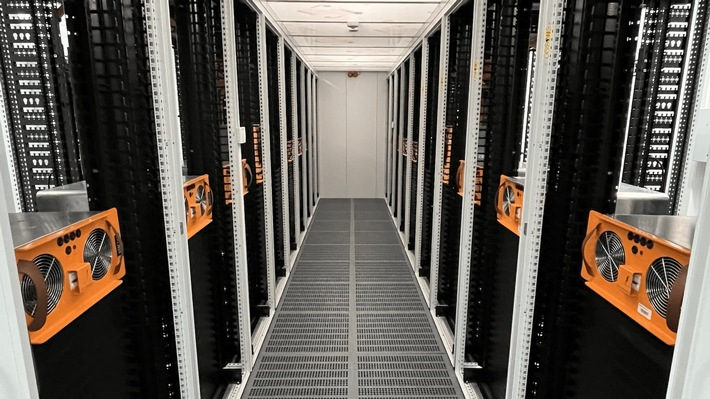
Designed in line with EN 50600, the facility will include redundant electrical and cooling systems, UPS capacity, emergency generation, layered physical security, biometric access, video monitoring, and support from a 24-hour network operations centre.
Regional colocation moves beyond floor space
Munich sits outside Germany’s largest concentration of data centre capacity around Frankfurt, yet its industrial, automotive, engineering, and technology base creates demand for local infrastructure with low-latency connections and accessible operational support.
M-net plans to connect the site to its fibre network at speeds of up to 800GbE, with redundant routes intended to preserve service during equipment failures or planned work. Their resilience will depend on physical separation beyond the building, since nominally diverse connections can still share ducts, road crossings, exchanges, or upstream nodes.
The same scrutiny applies to redundant power and cooling. Two systems can remain vulnerable to a common failure when they share switchgear, control logic, fuel infrastructure, pipe routes, or external utility equipment. EN 50600 provides a framework for availability, security, energy efficiency, and operational management, but performance follows from the selected availability class and the way the standard is implemented.
M-net has not published the facility’s rated IT load in its primary release. Without that figure, the expected rack density, incoming electrical requirement, and provision for future expansion cannot be assessed reliably.
The cooling design also remains undisclosed. A facility marketed for AI workloads will need to define whether it can accept direct-to-chip cooling, rear-door heat exchangers, or other liquid systems, alongside the air-cooled racks likely to make up much of its initial customer base.
A sub-1.2 PUE target faces the occupancy curve
M-net intends to purchase renewable electricity and achieve a PUE below 1.2. The target would place the building among more efficient colocation facilities, although annual performance will vary as occupancy increases and customer equipment creates different airflow, temperature, and power-density requirements.
New facilities rarely open at their final design load. Cooling plant, UPS equipment, and electrical distribution may operate less efficiently while customer installations are incomplete, leaving early-year PUE above the design case even where the underlying plant performs correctly.
German energy-efficiency policy places further attention on operating data, renewable electricity, and recovered heat. M-net has not announced a heat-reuse connection, despite the potential availability of nearby commercial and municipal heat users in an urban market.
Connecting a site to a heat network would require an agreed customer, suitable return temperatures, heat pumps where necessary, metering, pumping, redundancy, and contracts covering periods when either the data centre or the recipient cannot supply or accept heat.
The urban setting can also impose restrictions around construction traffic, acoustic performance, generator exhaust, testing hours, and the placement of outdoor cooling plant. Those conditions become more demanding when higher rack densities require larger electrical and thermal systems inside a relatively compact site.
With an operating target in 2028, M-net has allowed time for construction, utility work, procurement, and integrated testing. The remaining technical disclosures — secured power, rack-density limits, cooling options, and heat-recovery plans — will show how far the building can support the workloads named in its commercial proposition.

