
Summary
- Vertiv has expanded its work with Dow and formed a new Solenis partnership for liquid-cooling fluid management.
- The arrangement combines coolant chemistry, flushing, filtration, monitoring, leak detection and maintenance services.
- No specific facility commissioning, independent efficiency result or contractual project capacity was announced.
Vertiv has expanded its collaboration with Dow and formed a new partnership with Solenis to provide coordinated fluid management for high-density liquid-cooled computing infrastructure. The arrangement, announced on 27 October, combines thermal equipment, fluid chemistry, monitoring and maintenance services rather than introducing a new data-centre facility.
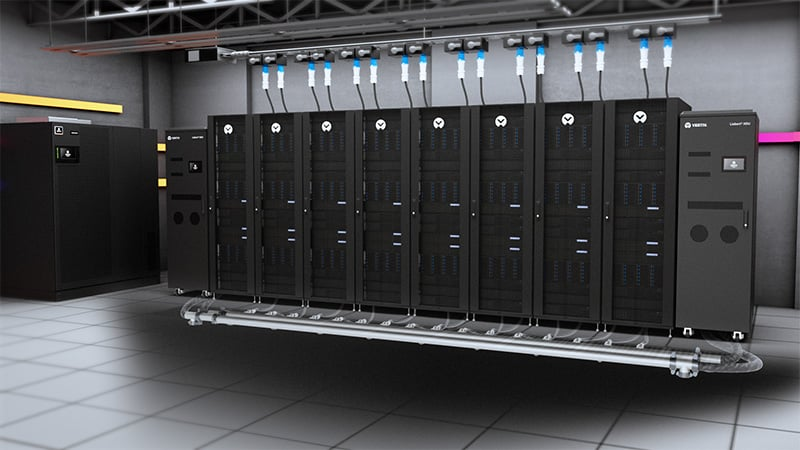
Dow contributes coolant technologies and associated support through its Coolant Care Network, while Solenis provides water treatment and specialty chemical expertise. Vertiv brings cooling infrastructure, controls, monitoring and lifecycle services. The companies intend to manage the thermal system as a connected set of components, including both facility-side and IT-side cooling loops.
DataCentral reported Vertiv’s completed acquisition of Irish cooling-services business King Environmental Services on 27 October. The Dow and Solenis arrangements are separate partnership developments and do not establish that a named UK or European facility has already adopted the combined services. They should not be described as another acquisition or a new operational data centre.
Fluid quality across the cooling chain
Direct-to-chip cooling transfers heat from processors and other high-power components into circulating liquid. That heat must then pass through coolant distribution equipment, piping, heat exchangers and a facility heat-rejection system. Performance depends on the interfaces between those stages and the ability to maintain appropriate operating conditions.
Different loops may use different fluids and materials. The technology loop serving IT equipment can have requirements that differ from those of a facility water system. Mixing incompatible treatments, seals or metals can create problems even where individual components operate as specified.
Fluid chemistry affects corrosion, biological growth, scaling and the transport of suspended material. These processes can restrict flow, contaminate equipment or reduce heat-exchanger performance. They are affected by temperature, water quality, material selection and the history of the installation, so there is no universal dosing approach applicable to every liquid-cooled system.
Vertiv says the new arrangement will address compatibility during design, engineered flushing, precision filling, filtration and ongoing maintenance. Commissioning procedures are particularly important because debris or residue left from fabrication and installation can circulate when a system first becomes operational.
Properly staged flushing and sampling can identify some potential problems before sensitive equipment is connected. However, a declaration that a loop is clean at commissioning does not guarantee that fluid quality will remain stable throughout its lifetime. Treatment and monitoring requirements can change as equipment is added, valves are operated and coolant is replaced.
Leak detection also has a distinct role. A monitoring system may identify abnormal moisture or fluid escape, but the operational response depends on sensor placement, system integration, isolation arrangements and how equipment is protected. A leak alarm alone does not establish that a facility can continue serving every affected load without interruption.
Monitoring and operating responsibility
The partnership will incorporate Vertiv’s Next Predict platform for monitoring and analysis. Data from thermal equipment and fluid management can help maintenance teams compare observed conditions with operating limits and identify developing changes rather than relying exclusively on fixed inspection intervals.
Useful monitoring may include flow, pressure, temperature and relevant fluid-quality indicators. A measured change in any one variable can have several possible causes. For instance, reduced heat transfer may reflect fouling, insufficient flow, altered load or an equipment-control issue. Analysis must therefore preserve context rather than treating a single reading as a definitive diagnosis.
High-density AI systems can impose varying thermal loads over short periods. Cooling controls must coordinate with workload behaviour and maintain adequate margins through transient conditions. Where multiple vendors supply different parts of the system, clear responsibility for thresholds, alarms and remedial action becomes important.
Vertiv aims to integrate chemical treatment, equipment monitoring and field services across the cooling system rather than manage each part as a separate supplier task. Operators will still need to specify thresholds, sample points, treatment responsibilities and procedures for responding to anomalies at their own facilities.
The business case will vary with the facility. A new high-density hall can incorporate compatibility requirements before commissioning, while an existing installation may need testing, replacement of parts or changes to maintenance practices. Costs and operational risk depend on the condition and design of the actual cooling system.
The companies also refer to improving water utilisation and lifecycle cost. Those remain expected benefits, not reported outcomes from an audited, named site. Water consumption and electrical efficiency would need to be measured using consistent boundaries and reference conditions before a savings claim could be applied to an individual operator.
A comprehensive fluid programme cannot replace adequate redundancy, plant capacity, engineering isolation or routine inspection. It can instead form part of the reliability strategy for systems in which cooling failures affect equipment availability and maintenance windows are constrained.
Vertiv’s expanded Dow collaboration and new Solenis partnership create a combined services proposition rather than a disclosed installation result. Before selecting it, operators would need fluid specifications, material compatibility evidence, commissioning arrangements and clearly defined long-term maintenance responsibilities for their particular thermal architecture.

