
Summary
- Spodegreen would occupy around 60 hectares near the M56 and A556 in Cheshire East.
- Plans include multiple data halls, backup power, solar, hybrid cooling, and a district-heating energy centre.
- Grid capacity and final electrical demand have not yet been disclosed.
Innova has unveiled plans for a roughly 60-hectare data centre campus at Little Bollington in Cheshire East, opening consultation on a multi-operator development that could move into formal planning during 2026/27.
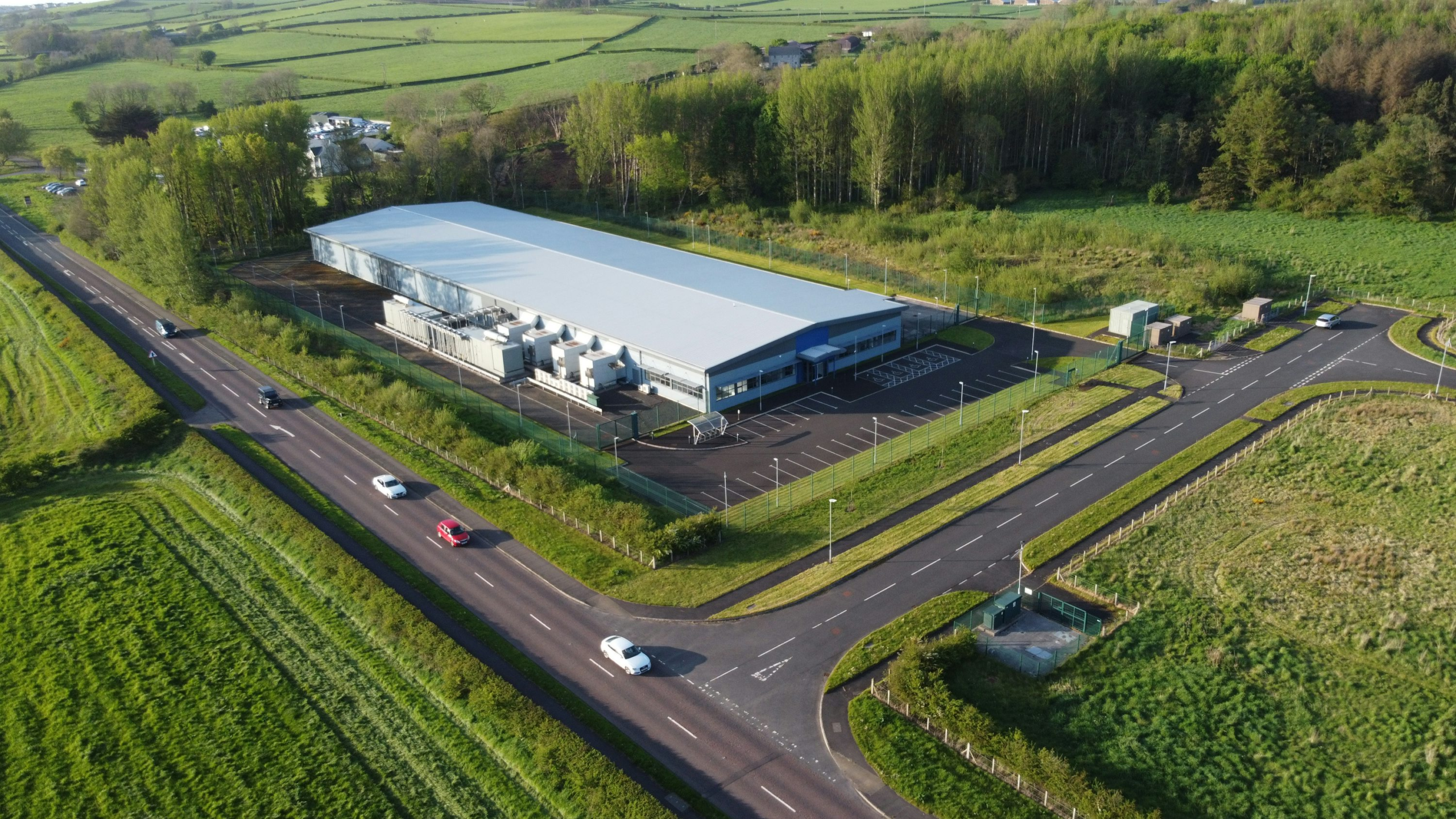
The proposed Spodegreen Data Centre would occupy land south of Lymm Road, north of the M56, and west of the A556. Emerging plans show multiple data halls alongside offices, security buildings, electricity infrastructure, backup generation, solar installations, and a district-heating energy centre.
Innova has not published the campus’s electrical capacity, grid connection agreement, number of data halls, or construction cost. Those omissions are important because the physical footprint alone does not establish how much computing load the site could ultimately support.
The developer says the campus is intended to host multiple operators. That model would place the project closer to a master-planned data centre estate than a single end-user facility, with common infrastructure potentially serving several separately occupied halls.
Cooling and heat reuse are in the early design
Spodegreen’s initial cooling concept combines air cooling with closed-loop water systems. Innova says the design is intended to minimise water consumption, although detailed water-balance figures, peak demand, and final mechanical specifications have not been published.
A hybrid design could allow different halls or rack populations to use different cooling methods. Conventional IT can continue to operate with air cooling while higher-density equipment is served by liquid systems, avoiding the need to design every part of a multi-operator campus around the same rack density.
The plans also include a district-heating energy centre. Innova is investigating whether recovered server heat could supply nearby businesses or properties and whether it could be reused within the site’s proposed offices and Living Lab.
Heat recovery at data centre scale depends less on the theoretical quantity of heat available than on whether there is a customer close enough to use it. Temperature, distance, heat-pump requirements, network ownership, seasonal demand, and commercial contracts all affect whether a proposed heat scheme progresses beyond the planning drawings.
Solar generation is proposed through a ground-mounted array west of Coe Lane, rooftop panels, and parking canopies. Innova says the solar farm is intended to generate an amount equivalent to the electricity consumed by the district-heating energy centre, offices, and Living Lab rather than the data halls themselves.
Power detail will determine the project’s scale
The data centre campus would connect to the local electricity network, but Innova has not disclosed a secured connection capacity or energisation date.
That is likely to become one of the most important points as the planning work progresses. A 60-hectare campus capable of hosting several operators could represent a substantial electricity demand, and the network infrastructure needed to serve it may have consequences beyond the site boundary.
Site surveys and environmental assessments are now under way. Innova has also submitted the site for consideration through Cheshire East Council’s emerging Local Plan process.
The developer estimates the completed campus could support around 350 full-time jobs and generate approximately £20m in additional business rates. Those are developer projections at this stage and will depend on the eventual scale, occupancy, valuation, and delivery of the campus.
A public consultation event is scheduled at High Legh Village Hall, with a second event planned once more detailed environmental and design work is available. Innova is also considering a community-benefit fund.
The site is well connected by road, sitting close to the M56 and A556, but data centre buildability will be determined much more heavily by electricity, planning, drainage, construction logistics, and network connectivity than highway access alone.
Spodegreen is therefore still an early-stage project. The 60-hectare boundary gives the proposal physical scale, but the numbers that will define the eventual data centre — secured megawatts, hall phasing, cooling loads, standby-generation requirements, and connection dates — have yet to emerge.

