
Summary
- SmartIT combines rack infrastructure, power conversion, direct-to-chip cooling and monitoring in a factory-validated design.
- Vertiv says the platform is available globally and supports multiple NVIDIA server architectures.
- Claims about simplified deployment are supplier expectations, without project-specific European operating results.
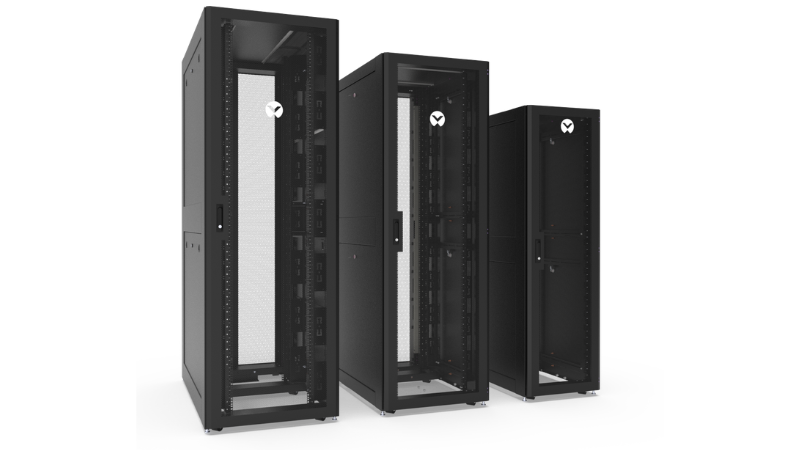
Vertiv has introduced SmartIT, a pre-engineered AI infrastructure platform integrating racks, DC power distribution, direct-to-chip liquid cooling and monitoring in a factory-validated design. The company says it is available globally for deployments ranging from individual racks to larger environments in new and existing facilities.
The 26 October announcement identifies support for NVIDIA MGX and Open Compute Project ORV3-based architectures, including systems associated with GB300 and Rubin computing platforms. SmartIT is a supplier product launch, not a disclosed commissioning of a European data centre, and the announcement gives no specific UK installation or project operating date.
The integration approach addresses an engineering difficulty arising when high-density server equipment arrives with power and cooling requirements that differ from the systems already installed in a building. A rack may be physically accommodated by the floor plan yet require upgraded electrical feeds, liquid cooling connections and controls before it can operate.
Factory integration and commissioning
Vertiv’s platform combines rack infrastructure, DC conversion and distribution, in-rack coolant distribution, liquid-cooling interfaces and monitoring. Factory validation is intended to check that these components function together before the package reaches the installation site.
Pre-assembled equipment can reduce some commissioning work and coordination among vendors, but not every site-level task disappears. Incoming utility power, upstream UPS capacity, chilled-water or facility cooling arrangements, drainage, leak management and fire protection must still be evaluated at the destination building.
Factory validation can confirm selected electrical and hydraulic interfaces before shipment, but it is not a substitute for commissioning the equipment at its intended site. The installed system must still be tested against local input power, coolant temperatures, safety provisions and the production workload it will carry.
The company says SmartIT can support enterprises, research institutions, colocation providers and hyperscale facilities. Those organisations have different ownership and maintenance arrangements. A colocation operator, for example, may supply cooling and electrical infrastructure while a tenant installs and manages computing equipment.
Clear interface responsibilities remain essential even with integrated equipment. Operators must establish which party maintains pumps, valves, sensors and protective devices, and which team is responsible for taking action if monitoring indicates an abnormal condition.
High-density AI systems can demand rapid changes in electrical input and thermal rejection. Control settings and protective devices need to respond to those transients, while facility cooling plant must maintain the temperature conditions required by the liquid circuit. Combining components into one product does not override those physical constraints.
Existing buildings and future expansion
Vertiv says the platform can be used in existing buildings, including enterprise premises and commercial spaces. Such use will depend on structural loading, fire design, access, electrical intake, cooling plant and network capacity. A design compatible with multiple rack arrangements does not prove that every office or enterprise facility can accommodate AI-class power density without substantial modification.
Modularity can assist phased deployment. Operators may start with one rack and add further units as customer workloads justify expansion. However, power and cooling infrastructure must be sized for the intended growth path, and later additions can require alterations to piping, electrical distribution and controls.
The platform incorporates monitoring and leak detection, with support for established communications interfaces including Redfish, SNMP and Modbus. These can make equipment status available to operations teams, but the quality of alarms and coordinated response depends on how systems are configured and connected to site management procedures.
Integrated leak detection is particularly important for direct-to-chip cooling because liquid circuits run close to sensitive electronics. Detection reduces the time required to identify abnormal fluid escape; it cannot ensure that leaks never occur or that every failure can be isolated without affecting equipment.
SmartIT is intended to work alongside other Vertiv infrastructure products, including row-level integration and site monitoring. The breadth of that portfolio offers potential coordination benefits while preserving the need to examine actual supplier interfaces, service boundaries and long-term maintenance costs.
The launch follows other developments in prefabricated AI infrastructure, including equipment assembled and tested before delivery to planned campuses. It should therefore be distinguished from an entirely novel method of construction. The fresh product proposition is the specific combination of racks, high-density power conversion, cooling and controls supported by Vertiv.
No independent comparison of installation time, operating energy demand or total lifecycle cost accompanies the announcement. Those outcomes would have to be measured against defined project baselines, particularly if a building needs substantial upstream electrical or cooling upgrades.
Vertiv says SmartIT is available globally now, but has not disclosed an independently benchmarked European installation. Site owners will have to test electrical capacity, cooling services, structural constraints and acceptance results before any claimed deployment advantage can be quantified against conventional procurement and integration.

